
0
NLMU3000A vs NLMU4500A: UAV Detection Laser Rangefinder Module Selection Guide
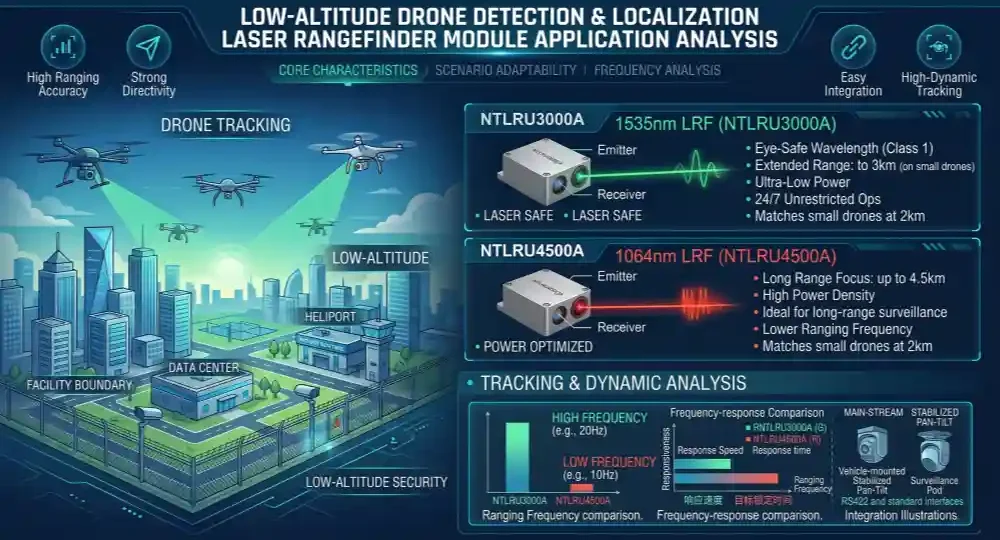
Can’t your electro-optical sensor detect small UAV targets 2km away? The bottleneck is often not laser power, but the matching between divergence angle and target size. This guide analyzes 3 quantitative relationships and structural matching selection strategies for 1535nm and 1064nm laser ranging modules.
Product Review of NLMU3000A and NLMU4500A
With the growth of low-altitude economy and rising demand for low-altitude security, long-distance detection, positioning and tracking of UAVs have become core requirements for security, border control and low-altitude airspace management. Featuring high ranging accuracy, strong directivity and excellent anti-electromagnetic interference performance, an integrated UAV detection laser rangefinder module serves as a core component of low-altitude UAV monitoring systems, electro-optical tracking platforms and ground surveillance equipment. This paper compares two professional UAV detection laser ranging modules, NLMU3000A (1535nm) and NLMU4500A (1064nm). We analyze their core specifications, scenario adaptability, as well as pros and cons of different ranging frequencies for tracking high-speed UAVs, to support equipment selection and project deployment.
For system integrators and border security contractors operating with large-scale low-altitude monitoring projects, our high-precision laser rangefinder modules deliver remarkable long-term operational savings. The NLMU3000A 1535nm eye-safe variant eliminates mandatory laser safety barriers, warning enclosures and on-site protective gear for staff, cutting auxiliary construction and labor costs significantly. Boasting ultra-low power draw and unrestricted 24/7 continuous operation, it avoids frequent equipment shutdowns, cooling downtime and routine maintenance interventions required by high-power 1064nm alternatives. Both modules feature universal RS422 communication and standard mechanical interfaces, enabling seamless plug-and-play integration with most mainstream stabilized electro-optical pan-tilts and surveillance pods already deployed on your existing vehicle-mounted, tower and UAV platforms, which drastically shortens project installation cycles and reduces custom adaptation expenses.
1. Core Difference: 1535nm Eye-Safe VS 1064nm Long-Range Laser Module
Both products are DPSS solid-state laser ranging modules designed for long-distance outdoor UAV ranging. They are compatible with mainstream consumer and industrial small multi-rotor UAVs (e.g., targets with a 0.2m×0.3m footprint), and can also detect pedestrians, vehicles and large buildings. However, they differ drastically in laser wavelength, eye safety class, detection range, power consumption and ranging frequency.
1.1 NLMU3000A (1535nm Eye-Safe Model)
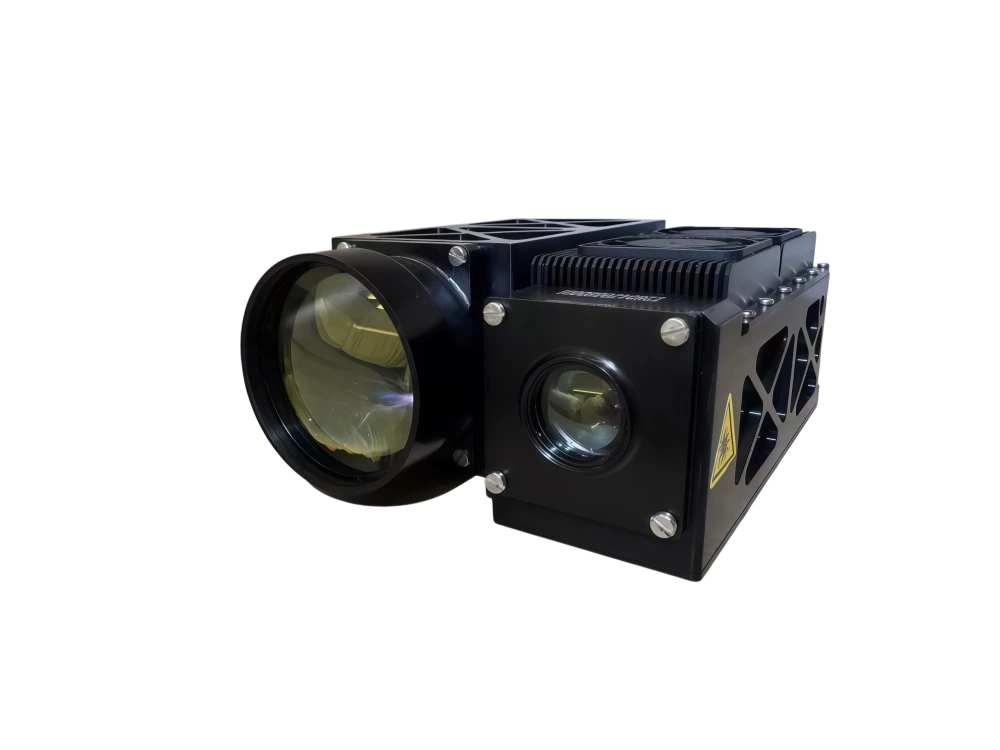
Adopting Class 1 eye-safe 1535nm laser, this dedicated 1535nm laser rangefinder module allows continuous long-hour operation without eye burn risks, making it the preferred choice for civil security and permanent monitoring. It highlights lightweight design, low power consumption, wide temperature tolerance and outstanding reliability.
- Ranging Performance: Minimum detection range reaches 2km for DJI Mavic 3 Pro (0.1m×0.2m UAV target) and 3km for DJI Phantom 4 (0.2m×0.3m UAV target). Maximum ranging distance for large targets hits 12km, with stable ±1m ranging accuracy, ≥99% ranging success rate and ≤1% false alarm rate.
- Mechanical Form Factor: Weight ≤660g, dimension 143mm×114mm×80mm, IP67 ingress protection. Operating temperature ranges from -40℃ to +60℃, suitable for harsh outdoor environments including extreme cold, high heat and sandstorms.
- Ranging Frequency: Supports single-shot ranging and continuous ranging with adjustable frequencies of 1Hz, 2Hz, 3Hz, 4Hz and 5Hz, without continuous operation limits under high frequency modes.
- Power Consumption & Interface: Powered by DC 22~34V. Standby power ≤1.5W; average power consumption is only 2.8W at 1Hz and 4.5W at 5Hz. Low power design enables integration on airborne and mobile platforms. Standard RS422 communication with multi-level adjustable baud rates. Built-in functions include laser self-test, temperature monitoring, serial firmware upgrade, first/last target identification and range gating.
1.2 NLMU4500A (1064nm Long-Range Enhanced Model)
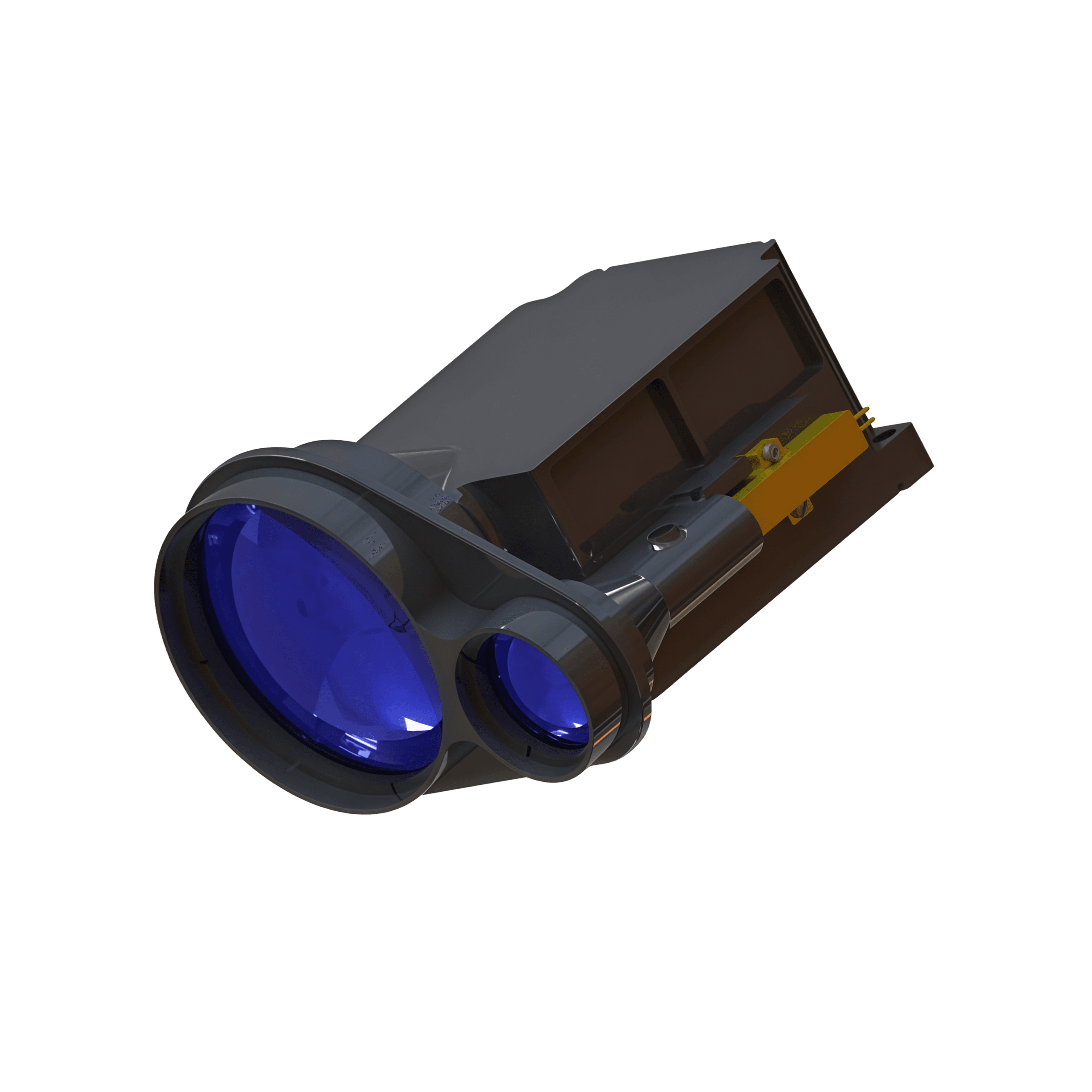
Equipped with 1064nm laser with energy ≥40mJ, this 1064nm laser rangefinder module delivers superior ranging performance yet lacks eye-safety protection. Direct exposure to laser emission aperture is strictly prohibited, so it is mainly deployed in professional security and border control sites with dedicated operators. It prioritizes ultra-long UAV detection range at the cost of lighter weight and low power draw.
- Ranging Performance: Under identical environmental conditions, its detection capability outperforms the 1535nm model. It can detect DJI Mavic 3 Pro from at least 3.5km and DJI Phantom 4 from at least 4.5km (visibility ≥10km, humidity ≤60%, target reflectivity 30%), with the same ±1m ranging accuracy.
- Mechanical Form Factor: Weight ≤1.5kg, dimension 160mm×120mm×66mm, IP67 rated. Operating temperature: -40℃~+60℃; wider storage temperature range: -55℃~+70℃.
- Ranging Frequency: Supports single-shot, 1Hz, 5Hz and 10Hz continuous ranging. The high-frequency mode comes with strict runtime limits: 3 minutes of cooling break is required after every 1 minute of continuous operation, disallowing long-duration high-frequency work.
- Power Consumption & Interface: Same power supply specification as the 1535nm model, yet drastically higher power consumption. Standby power ≤10W, average power ≤80W, peak power up to 140W. Equipped with RS422 interface, supporting secondary development via matched upper computer software and SDK. It also integrates range gating, first/last target ranging and device self-test functions.
2. Scenario Application Analysis of the Two Laser Ranging Modules
Differentiated by wavelength, detection range, eye safety, power consumption and frequency, the two modules serve two major application categories: permanent civil security/mobile integration, and long-distance professional monitoring/fixed-site deployment. They fully cover UAV detection, border security, low-altitude airspace management and vehicle-mounted reconnaissance.
2.1 Shared Applicable Scenarios for Both Modules
2.1.1 Low-Altitude Security & Perimeter Monitoring
Both modules feature ±1m ranging accuracy, deployable at industrial parks, airports, ports and large manufacturing zones to provide early warning and trajectory tracking of unauthorized UAV flights. Paired with electro-optical pan-tilt units, they can lock rogue UAVs precisely and trigger audible & visual alarms or countermeasure devices for regular urban low-altitude management. IP67 rating and wide temperature support all-weather outdoor deployment against rain, snow and sand.
2.1.2 Vehicle-Mounted Mobile Detection Platforms
Both modules can be integrated onto security patrol vehicles and border inspection vehicles for full-range mobile surveillance. Built with high ruggedization to withstand frequent temperature fluctuations and vibration on moving vehicles, they stably detect low-altitude UAVs, suspicious vehicles and pedestrians along patrol routes.
2.1.3 Border & Coastal Defense
Border and coastal regions feature vast terrain and harsh climates (extreme cold, high humidity, strong wind). The -40℃~+60℃ operating temperature range adapts to frigid and torrid border areas. Long-distance ranging compensates sparse monitoring stations to screen wide-area UAVs and illegal moving targets, acting as key sensing equipment for three-dimensional border defense systems.
2.2 Exclusive Advantages & Scenarios of NLMU3000A (1535nm)
Its core strengths – eye safety, lightweight, low power and unlimited continuous high-frequency operation – make it ideal for mobile integration, unmanned platforms and crowded public areas.
2.2.1 Airborne Payload for Reconnaissance UAVs
Weighing under 700g with ultra-low power draw, this module can be mounted directly on inspection & surveillance UAVs to realize “UAV-hunting-UAV” detection. Class 1 eye-safe laser poses no ocular hazards even when the beam sweeps ground crowds and buildings, suitable for UAV monitoring over urban and residential airspace. Long continuous runtime will not drain the host UAV’s battery.
2.2.2 Permanent Monitoring for Indoor & Outdoor Public Venues
Malls, stadiums, scenic spots and government compounds require strict laser safety standards. The 1535nm eye-safe design allows 24/7 non-stop operation with unrestricted installation angles, no separate laser warning zones needed. It prevents illegal UAV flights and secret photography in crowded areas.
2.2.3 Integration into Portable Reconnaissance Devices
Lightweight construction enables assembly into handheld portable detectors for security and patrol staff. Operators can flexibly detect concealed small UAVs inside complex blocks and buildings, while low power extends portable device battery life.
2.3 Exclusive Advantages & Scenarios of NLMU4500A (1064nm)
Boasting ultra-long detection range, short-term 10Hz high-frequency tracking and high laser energy, this module targets long-distance fixed-site professional monitoring.
2.3.1 Long-Range Low-Altitude Defense & Critical Facility Protection
Restricted zones, confidential institutes and large energy bases demand maximum UAV detection distance. It can spot DJI Phantom 4 UAVs from 4.5km away, triggering early warnings before UAVs enter core controlled zones and leaving sufficient response time for countermeasure systems. These sites are staffed by dedicated operators to mitigate its non-eye-safe drawback.
2.3.2 Wide-Area Airspace Screening for Open Terrain
On flat plains, grasslands and deserts with unobstructed views, 1064nm laser minimizes atmospheric attenuation. Mounted on fixed high towers, a single unit covers several square kilometers of airspace for mass UAV screening. The short-term 10Hz high-frequency mode rapidly captures fast-moving maneuverable UAV targets.
2.3.3 Supporting Equipment for Professional Electro-Optical Tracking Systems
Integrated into large electro-optical pods and high-precision stabilized observation platforms, it forms a multi-spectrum tracking system together with visible light and infrared cameras. Short-burst high-frequency ranging enables pan-tilts to follow fast targets swiftly, and ultra-long detection range supports long-distance target locking for professional security and emergency search & rescue missions.
Scenario Selection Summary
- Prioritize NLMU3000A for projects requiring eye safety, lightweight design, all-day continuous operation and mobile integration (UAV payloads, crowded-area monitoring, portable detectors).
- Prioritize NLMU4500A for ultra-long detection range, short-burst high-frequency tracking and fixed-site long-distance defense (critical facilities, open border zones, professional electro-optical platforms).
- Both modules shall avoid direct sunlight, drastic temperature swings and strong electrostatic environments. The two products are clearly designated for civil security and industrial monitoring only, prohibited for military applications.
3. Pros & Cons of Different Ranging Frequencies for High-Speed UAV Detection
High-speed UAVs generally fly over 10m/s; racing or evasive UAVs can reach 20~30m/s. The pulse repetition frequency (PRF) of laser ranging modules directly impacts sampling density, trajectory continuity, tracking responsiveness, power consumption, ranging stability and equipment lifespan. We analyze low, medium and high frequency modes based on the frequency gears of the two modules (1Hz~5Hz, 10Hz).
3.1 Low Frequency Gear (1Hz: 1 Ranging Sample Per Second)
1Hz is the base frequency supported by both modules, featuring the lowest power consumption and longest continuous runtime.
Core Advantages:
- Minimal power consumption & maximum stability: NLMU3000A consumes merely 2.8W average power at 1Hz with 1.5W standby power. It generates minimal heat during long-hour operation, slowing component aging and fitting 24/7 uninterrupted monitoring.
- Maximum detection range & low false alarm rate: Concentrated single laser pulse energy reduces atmospheric interference and clutter reflection. Both modules reach their nominal maximum ranging distance under 1Hz, delivering ≥99% detection success rate for distant mini UAVs with false alarm rate controlled below 1%.
- Low data throughput: Only one ranging dataset per second places minimal burden on backend control, storage and communication links, compatible with basic embedded controllers and highly system-adaptive.
Core Drawbacks (For High-Speed UAVs):
- Long sampling intervals create fragmented trajectories: One sample per second means high-speed UAVs can travel 10~30m between two data points, leaving massive time blind zones. Operators can only detect targets but cannot restore complete flight paths or calculate velocity and heading.
- High risk of target loss: Rapid UAV direction changes easily skip single sampling shots, causing intermittent target signals and failing to sustain pan-tilt lock.
- Applicable Scenarios: Wide-area static screening, long-distance early warning, low-speed UAV monitoring; not recommended for high-speed UAV tracking.
3.2 Medium Frequency Gear (2Hz~5Hz: 2–5 Samples Per Second)
This is the primary operating range of NLMU3000A with unlimited continuous runtime, also the mainstream frequency for both modules. It balances sampling density, power consumption and stability as the optimal choice for general high-speed UAV tracking.
Core Advantages:
- Greatly improved trajectory continuity: At 5Hz, 5 samples are captured every second with a 0.2-second interval. A 20m/s high-speed UAV only travels 4m between samples, enabling clear restoration of straight flight and minor course changes. Backend algorithms accurately calculate real-time UAV speed and heading to meet regular high-speed tracking demands.
- Controllable power for non-stop all-day operation: NLMU3000A consumes 4.5W average power and peak 6.2W at 5Hz, staying within low-power category with mild heat generation for 24/7 operation. Moderate laser pulse density avoids cumulative atmospheric scattering interference seen in high-frequency modes.
- Minor ranging performance attenuation: Compared with 10Hz high frequency, sufficient pulse reset intervals preserve nominal ±1m accuracy and maximum detection distance, balancing range and refresh rate.
- Full functional utilization: Combined with first/last target identification and range gating, the system distinguishes primary targets from background clutter and stably locks single fast UAVs amid multi-UAV airspace.
Core Drawbacks:
- Limitations against extreme high-speed targets: For racing or escape UAVs exceeding 30m/s, the 0.2-second interval leaves small blind zones, risking temporary target loss during sharp turns, dives or climbs.
- Moderately increased data volume: 5x data throughput versus 1Hz imposes slight processing pressure on low-end basic controllers.
- Applicable Scenarios: Mainstream low-altitude security, UAV airborne detection, vehicle-mounted mobile surveillance, general high-speed UAV tracking (industry standard frequency).
3.3 High Frequency Gear (10Hz: 10 Samples Per Second, Exclusive to NLMU4500A with Runtime Limits)
The 10Hz high-frequency mode is unique to NLMU4500A with the highest sampling density, defined as a short-burst intensive working mode (1 minute operation + 3 minutes cooling break).
Core Advantages:
- Top-tier tracking capability for extreme high-speed targets: 0.1-second sampling intervals cut travel distance between samples down to only 3m for 30m/s ultra-fast UAVs, minimizing time blind zones. Pan-tilts follow sharp turns, rolls and dives instantly with drastically reduced target loss risk, ideal for emergency tracking and rapid countermeasure deployment.
- High sensitivity for dynamic target capture: Dense short-burst sampling rapidly identifies newly-launched or suddenly intruding UAVs, delivering far faster early warning response than medium/low frequencies for emergency handling of unauthorized flights.
Core Drawbacks (Severe Restrictions Limiting Deployment):
- Restricted continuous runtime: Mandatory 3-minute cooling after every minute of operation forbids 24/7 high-frequency permanent monitoring, only usable as emergency trigger mode.
- Skyrocketing power consumption & heat generation: 80W average power and 140W peak power overheat laser emitters during extended high-frequency work, accelerating hardware aging, reducing ranging accuracy and detection distance, or triggering thermal protection shutdowns.
- Noticeable ranging performance degradation: Continuous dense laser pulses amplify atmospheric scattering and lens stray light interference, cutting maximum detection range by 10%~20% and lowering capture success rate for distant mini UAVs.
- Heavy system load: 10 datasets per second raise high requirements for communication bandwidth, backend algorithms and pan-tilt response speed, increasing overall integration costs due to demand for high-performance controllers and high-speed pan-tilts.
- Elevated laser safety hazards: The non-eye-safe 1064nm laser’s energy density accumulates under continuous high-frequency emission, raising risks of eye and skin burns upon close contact.
- Applicable Scenarios: Emergency response, short-duration high-speed UAV interception, sudden target pursuit, special tasks; strictly prohibited for permanent monitoring.
Comprehensive Comparison & Frequency Selection Guide
| Frequency Gear | Supported Model | Advantages for High-Speed UAV Detection | Core Shortcomings | Best Applicable Scenarios |
|---|---|---|---|---|
| Low 1Hz | Both modules | Lowest power, maximum detection range, ultra-long stable runtime | Fragmented trajectories, frequent target loss on fast UAVs | Long-distance fixed early warning, full static airspace screening |
| Medium 2–5Hz | NLMU3000A (main) | Smooth target trajectories, controllable power, unlimited continuous operation, balanced overall performance | Occasional temporary lock loss during extreme UAV maneuvers | Regular low-altitude security, airborne/vehicle-mounted detection (preferred mainstream solution) |
| High 10Hz | NLMU4500A (limited runtime) | Highest sampling density, superior tracking of ultra-fast maneuverable UAVs | Limited runtime, extreme power draw, degraded ranging performance, higher system cost | Emergency interception, short-term pursuit of evasive high-speed UAVs |
4. How PRF (1Hz/5Hz/10Hz) Impacts High-Speed Drone Tracking
4.1 Product Positioning Overview
NLMU3000A (1535nm) is a universal permanent UAV detection laser ranging module. Its core strengths of eye safety, lightweight build, low power and unrestricted full-frequency continuous operation fit most civil scenarios including crowded public zones, UAV airborne payloads, portable detectors and round-the-clock monitoring, delivering superior comprehensive practicality.
NLMU4500A (1064nm) is a long-range dedicated detection module focused on ultra-long detection distance and short-burst high-frequency tracking. It suits fixed professional monitoring sites in open areas and confidential critical facilities, oriented toward emergency special tasks with multiple usage constraints.
4.2 Core Frequency Selection Principles
- For permanent monitoring and regular high-speed UAVs: Prioritize 2–5Hz medium frequency gears; NLMU3000A is recommended to balance tracking performance, equipment lifespan and operating costs.
- For long-distance early warning and low-activity airspace: Adopt 1Hz low frequency gear to maximize detection range and system stability.
- For emergency interception and pursuit of ultra-fast escaping UAVs: Temporarily activate NLMU4500A’s 10Hz high-frequency mode, strictly following the 1-minute-on, 3-minute-off cycle to avoid hardware damage.
4.3 Supplementary Deployment Tips
Both modules shall be kept away from direct strong sunlight, drastic temperature fluctuations and heavy static electricity environments. When integrated into stabilized pan-tilt platforms, ensure sufficient tracking precision of the pan-tilt unit; otherwise, the ranging module’s accuracy advantages will be offset. Conduct comprehensive selection based on local UAV flight speed, required monitoring duration and crowd density, balancing laser safety, detection range, tracking performance, power consumption and equipment lifespan to maximize the sensing value of laser ranging modules in low-altitude UAV defense systems.
Beyond upfront hardware compatibility, our dual-series ranging modules optimize your whole-lifecycle operation efficiency for permanent security deployments. The 1535nm model’s round-the-clock stable performance removes the need for extra duty rosters to monitor laser heat limits, ideal for crowded urban venues, airports and residential airspace surveillance where uninterrupted drone detection is legally required. For remote border outposts with limited maintenance personnel, the IP67 weatherproof housing and wide -40℃ to +60℃ operating range minimize field failure rates in desert, snowy and coastal harsh environments. Even when you select the long-range NLMU4500A for critical facility defense, its standardized SDK and upper computer software lower R&D costs for secondary development, allowing your engineering team to fast-track anti-UAV early warning linkage systems without expensive custom programming.
5. NLMU3000A vs NLMU4500A Laser Ranging Module Full Parameter Comparison Table
| Parameter Category | Detailed Parameter Item | NLMU3000A (1535nm Eye-Safe Model) | NLMU4500A (1064nm Long-Range Model) |
|---|---|---|---|
| Basic Product Information | Product Model | NLMU3000A | NLMU4500A |
| Core Positioning | Universal permanent UAV detection & ranging module for civil security, mobile integration & 24/7 monitoring | Long-range dedicated UAV detection module for fixed professional monitoring & emergency special tasks | |
| Laser Safety Grade | Class 1 Eye-Safe (1535nm), safe for long-term continuous operation | Non-Eye-Safe (1064nm), direct eye exposure strictly prohibited | |
| Laser Core Optical Parameters | Laser Wavelength | 1535nm | 1064nm±10nm |
| Single Pulse Laser Energy | Not specified | ≥40mJ | |
| Beam Divergence | ≥1mrad | ≥1mrad | |
| Minimum Ranging Blind Zone | ≤100m | ≤200m | |
| Ranging Performance Parameters | Core UAV Ranging Range (0.1m×0.2m Target) | ≥2km (under standard environmental conditions) | ≥3.5km (visibility ≥10km, relative humidity ≤60%, target reflectivity 30%) |
| Core UAV Ranging Range (0.2m×0.3m Target) | ≥3km (under standard environmental conditions) | ≥4.5km (visibility ≥10km, relative humidity ≤60%, target reflectivity 30%) | |
| Ranging Accuracy | ≤±1m | ±1m | |
| Ranging Distance Resolution | ≤38m | ≤38m | |
| Working Mode & PRF | Supported Ranging Modes | Single-shot, Continuous Ranging | Single-shot, Continuous Ranging |
| Adjustable Pulse Repetition Frequency | 1Hz, 2Hz, 3Hz, 4Hz, 5Hz | 1Hz, 5Hz, 10Hz | |
| High-Frequency Mode Operation Limit | No time limit, supports 24/7 continuous operation at all frequencies | 10Hz mode: 1 minute continuous operation + 3 minutes cooling break required, no long-duration high-frequency work allowed | |
| Electrical Performance Parameters | DC Supply Voltage Range | 22V ~ 34V | 22V ~ 34V |
| Standby Power Consumption | ≤1.5W | ≤10W | |
| Average Operating Power Consumption | ≤2.8W (@28V, 1Hz); ≤4.5W (@28V, 5Hz) | ≤80W | |
| Peak Operating Power Consumption | ≤4.5W (@28V, 1Hz); ≤6.2W (@28V, 5Hz); Startup peak ≤50W | ≤140W | |
| Standard Communication Interface | RS422 (Isolated) | RS422 | |
| Adjustable Baud Rate | 115200 bps (Default) / 57600 bps / 38400 bps / 9600 bps | 38400 bps (Default) / 9600 bps / 57600 bps / 115200 bps | |
| Electrical Interface Connector Model | Host Plug: J30J-9TJL; Rangefinder Receptacle: J30J-9ZKP | Rangefinder Socket: J30J-15ZKP; Matching Plug: J30J-15TJL | |
| Mechanical & Environmental Parameters | Overall Dimensions | ≤143 × 114 × 80mm | ≤160 × 120 × 66mm |
| Net Weight | ≤660g | ≤1.5kg | |
| Ingress Protection Grade | IP67 | IP67 | |
| Operating Temperature Range | -40℃ ~ +60℃ | -40℃ ~ +60℃ | |
| Storage Temperature Range | -45℃ ~ +70℃ | -55℃ ~ +70℃ | |
| Ruggedization Grade | Industrial / Ruggedized | Industrial / Ruggedized | |
| Core Built-in Functions | Laser Ranging | ✅ | ✅ |
| First/Last Target Ranging & Identification | ✅ | ✅ | |
| Range Gating Function | ✅ | ✅ | |
| Built-in Laser Self-Test & Status Query | ✅ | ✅ | |
| Ambient Temperature Acquisition & Monitoring | ✅ | ✅ | |
| Power-on Monitoring & Real-Time Status Feedback | ✅ | ✅ | |
| Serial Port Firmware Upgrade | ✅ | ✅ | |
| Core Application Scenarios | Drone Targeting & Surveillance | ✅ (Universal for civil low-altitude security) | ✅ (Specialized for long-range professional monitoring) |
| Perimeter Security & Critical Area Monitoring | ✅ | ✅ | |
| Border/Coastal Defense & Outdoor Reconnaissance | ✅ | ✅ | |
| Low-Altitude Airspace Management | ✅ | ✅ | |
| UAV Airborne Payload Integration | ✅ (Lightweight & low-power ideal for drone mounting) | ❌ (Heavy weight & high power not suitable for small UAVs) | |
| Portable Handheld Detection Devices | ✅ | ❌ | |
| 24/7 Permanent Monitoring in Crowded Public Areas | ✅ (Eye-safe design) | ❌ (Non-eye-safe, requires dedicated operators) | |
| Emergency Interception & High-Speed UAV Pursuit | ⚠️ (Suitable for regular high-speed UAVs) | ✅ (10Hz high-frequency mode for extreme high-speed targets) |
Supplementary Notes for Both Products
- Nominal ranging performance and accuracy are achieved under standard environmental conditions (relative humidity ≤60%, good visibility). Actual performance may vary with different environments, target reflectivity and weather conditions.
- Both products shall avoid exposure to direct strong sunlight, rapid temperature fluctuations, and strong electrostatic environments.
- Both products are strictly designated for civil security and industrial monitoring applications only, prohibited for military use.
- When integrated into a stabilized pan-tilt platform, ensure the platform can stably track the target; otherwise, the ranging range or accuracy may be affected.
Looking for Integration Support or Custom Evaluation Samples?
Our engineering team provides comprehensive interface control documents (ICD), serial communication protocols, and custom optical/structural solutions for electro-optical pods, pan-tilt units, and drone tracking systems.
Frequently Asked Questions (FAQ)
Q1: What key factor limits small drone detection distance besides laser power?
A1: As covered in our core technical analysis, laser ranging beam divergence matching the UAV target size determines effective detection performance far more than raw laser power. Even high-energy 1064nm lasers will suffer poor signal return if the beam footprint is much larger than tiny consumer UAVs. Both NLMU3000A and NLMU4500A adopt optimized ≥1mrad beam divergence calibrated for 0.1–0.3m small drone targets to guarantee stable echo signals at maximum nominal range.
Q2: Can I install the 1535nm module at crowded public sites without laser safety enclosures?
A2: Yes. NLMU3000A’s Class 1 1535nm eye-safe laser meets international laser safety standards. No physical isolation fences, warning zones or operator protective goggles are required, which cuts your construction and long-term operation costs. This design is widely approved for malls, stadiums, airports and residential low-altitude monitoring projects.
Q3: Is the NLMU3000A fully compatible with mainstream third-party electro-optical pan-tilt platforms?
A3: Absolutely. It uses universal RS422 serial communication and standard mechanical mounting dimensions. No customized circuit modification is needed to integrate with most stabilized electro-optical tracking pods already deployed for border surveillance, vehicle patrol and tower monitoring. The factory-provided serial protocol document simplifies fast docking with your existing control system.
Q4: What’s the difference in long-term operation cost between NLMU3000A and NLMU4500A?
A4: NLMU3000A delivers far lower O&M costs for 24/7 permanent monitoring. Its ultra-low power consumption generates minimal heat, eliminating mandatory cooling downtime and reducing power bills year-round. The 1064nm NLMU4500A requires regular heat dissipation breaks at 10Hz high frequency, demanding extra power supply capacity and periodic on-site inspections, making it only cost-effective for short-term emergency interception scenarios.
Q5: Can both modules work stably in extreme cold border and high-temperature desert environments?
A5: Both units support -40℃ to +60℃ continuous operation with IP67 dustproof and waterproof protection. For long-term outdoor deployment in snow, sandstorm or coastal high-humidity areas, we recommend adding a simple sunshade housing to avoid direct long-time sunlight exposure and extend service life. The storage temperature range differs between the two models for cold-area stock storage planning.
Q6: Does the NLMU4500A SDK support secondary development for customized early warning linkage systems?
A6: Yes. NLMU4500A comes with full SDK, upper computer analysis software and complete serial communication protocol files for secondary development. The NLMU3000A supports firmware upgrade via serial port, and we provide universal protocol documents for basic linkage without dedicated SDK packages.
Q7: If I only need to monitor low-speed drones with long-distance early warning, which PRF mode should I select?
A7: We recommend the 1Hz low-frequency mode. It offers the farthest effective detection range, the lowest false alarm rate and minimum backend data processing pressure, ideal for unattended border tower early warning systems with limited embedded controller performance.
Q8: Can the 10Hz high-frequency mode of NLMU4500A run around the clock for continuous drone tracking?
A8: Not allowed by hardware thermal protection design. The 10Hz mode is restricted to 1 minute of operation followed by a 3-minute cooling interval, exclusively for emergency capture of fast-evading racing UAVs. Long-duration high-frequency use will trigger overheating protection and shorten the module’s service lifespan.
Q9: What after-sales technical support do you offer for system integration?
A9: We supply free protocol manuals, dimension drawings and pin definition tables for all models. Our engineering team provides remote technical guidance for pan-tilt matching, frequency parameter debugging and firmware upgrades. For bulk security projects, on-site technical training can be arranged upon request.